Showing posts with label gas appliances. Show all posts

Saturday, January 23, 2016

Clear Snow From Your Vents

co vent pipe
Vent pipe on side of home. Intake
& exhaust
The Montgomery County Fire and Rescue Service has seen an increase in the number of carbon monoxide incidents and detector activations due to snow accumulation and build-up. As you head outside to dig out of your driveway and clear your sidewalks, there are some other places around your home you may have to clear.

A common problem is high snow drifts that block furnace vents and air intakes in some homes, predominantly those that have newer high-efficiency furnaces. New, high efficiency furnaces vent out the side of a home rather than up through the roof. These vents and air intakes must be kept clear of snow. If they are blocked, the carbon monoxide will go back into the home. Some newer high efficiency furnaces have automatic shut-off’s that shutdown the furnace when the vents are blocked, but not all of them. As a general rule you should keep a three-foot area clear around the vent and intake tubes. After any snowfall it is important to inspect the area around the furnace and hot water heater vents to ensure that snow and ice are not blocking the safe operation of these fuel burning devices. Homeowners should keep a three- foot area around the vents clear of snow, shrubs, or other potential obstructions. Heating and dryer vents should also be cleared of snow to prevent possible carbon monoxide poisoning. NEVER run generators in the home, garage or other enclosed spaces as carbon monoxide can rise to dangerous, if not fatal levels. If your CO alarm sounds, immediately evacuate to a safe location and call 9-1-1. 

Friday, January 27, 2012

What’s Invisible, Has No Smell, But Can Kill You? Carbon Monoxide


Carbon monoxide is the most common cause of death by poison in the United States, killing more than 500 people every year. It is one of the most dangerous poisons because often people don't know it is present until it is too late. The best way to protect yourself and your family from carbon monoxide poisoning is to buy a carbon monoxide (sometimes referred to as CO) detector for your home. A properly working carbon monoxide detector can provide an early warning before deadly gases build up to dangerous levels. If you live in a home that is two stories or more, you might want to install two.
For more information, see the "Is it Flu or Carbon Monoxide Poisoning?" page.
If you notice these symptoms and suspect that carbon monoxide is the cause, leave the area immediately and get outside to fresh air. Call 9-1-1 and seek medical help.
Be reminded: Installing a carbon monoxide detector does not eliminate the need to have a smoke alarm in your home. Carbon monoxide detectors do not detect smoke and smoke alarms do not sense carbon monoxide.
CO poisoning is the leading cause of accidental poisoning deaths in America.
(Source: Centers for Disease Control)

Facts

·         CO is a produced anytime a fuel is burned. Potential sources include gas or oil furnaces, water heaters, space heaters, clothes dryers, barbecue grills, fireplaces, wood-burning stoves, gas ovens, generators and car exhaust fumes.
·         Every year more than 10,000 people die or seek medical attention due to CO poisoning from home-related products. (Source:  Consumer Product Safety Commission)
·         More than two-thirds of Americans use gas, wood, kerosene or another fuel as their home's major heat source.
·         65% of CO poisoning deaths from consumer products are due to heating systems.
·         Only 27% of homes in America have carbon monoxide alarms, according to recent industry research.
·         An idling vehicle in an attached garage, even with the garage door opened, can produce concentrated amounts of CO that can enter your home through the garage door or nearby windows.
·         CO poisoning deaths from portable generators have doubled for the past two years, and many of these deaths occurred in the winter months and during power outages.
·         A poorly maintained gas stove can give off twice the amount of CO than one in good working order.

Prevention

·         Install at least one battery-powered CO alarm or AC-powered unit with battery backup on each level of your home and near sleeping areas.
·         Have a licensed professional inspect heating systems and other fuel-burning appliances annually.
·         Install fuel-burning appliances properly and operate according to the manufacturer's instructions.
·         Keep chimneys clear of animal nests, leaves and residue to ensure proper venting. Have all fireplaces cleaned and inspected annually.
·         Do not block or seal shut the exhaust flues or ducts used by water heaters, ranges and clothes dryers.
·         Do not leave your car running in an attached garage or carport.
·         Do not use ovens or stoves to heat your home.
·         Do not use charcoal or gas grills inside or operate outdoors near a window where CO fumes could seep in through a window.
·         Check all carbon monoxide alarms in your home. Do they use the most accurate sensing technology? Do they need new batteries?
Replace CO alarms every five to seven years in order to benefit from the latest technology upgrades.

Wednesday, May 4, 2011

Rockville Home Destroyed by Gas Explosion

IMMEDIATE RELEASE: May 4, 2011


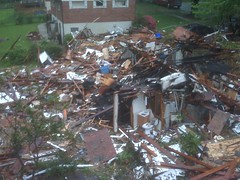
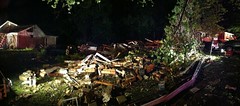
Ashley Drive Incident Rockville - - Just before 3 a.m. today, Montgomery County Fire and Rescue was called to the 11200 block of Ashley Drive in Rockville for a report of a house explosion. Units arrived on the scene and found a single family rancher style home that was completely destroyed. Two adult occupants, one male and one female, were located at the rear of the residence under debris and were treated and transported to a local burn center. The adult male remains in serious condition and the female remains in serious condition with life threatening injuries.

Montgomery County Fire and Explosive Investigators report the explosion was caused by an improperly installed natural gas dryer. The explosion caused an estimated $750,000 damage to the structure and two adjacent homes. Debris from the home was distributed in a wide area surrounding the home.

ASHLEY DR IncidentSeventy-five fire and rescue personnel were on the scene for approximately 1 ½ hours. Investigators remained on the scene for an additional eight hours. Washington Gas and Pepco representatives were on the scene to assist with the incident and investigation.

Gas appliances should be installed by a licensed professional.

# # #