The combination of strenuous work, heavy and encapsulating personal protective equipment (PPE), hot and hostile fire conditions, and high adrenaline levels leads to significant cardiovascular strain during firefighting. As the National Institute for Occupational Safety and Health (NIOSH) reports, in a typical year, more than 100 firefighters die in the line of duty, and by far the leading cause of line-of-duty deaths is sudden cardiac events.
To help combat these alarming statistics, New York University (NYU) is developing a web-based interactive training module to educate firefighters about the physiological impacts of firefighting.
This Advanced Learning Through Integrated Visual Environments (ALIVE) training module will focus on improving understanding of the individual factors that predispose firefighters to a high risk for injury and cardiac death, how firefighting may serve as a trigger for cardiac events, and strategies and techniques that are effective in reducing cardiovascular strain. This training will help firefighters improve their cardiovascular health and, in the long-term, may reduce nationwide firefighter injuries and deaths due to sudden cardiac events.
Why my interest? I am one of those firefighters who suffered a cardiac event. While on duty September 3, 2015, I developed non-classic symptoms that felt like another medical issue which caused me to seek medical attention. As it turned out, I had a 100% block of my left anterior descending artery, commonly referred to as the widow maker, and was rushed to the hospital and underwent an emergency cardiac catheterization. This form of cardiac event has a 97% fatality rate. I am now one of only 3% who survive this form of heart attack!
A NYU research coordinator heard about my event and as part of the project of interviewing firefighters who suffered a cardiac event, or surviving families and friends, asked if they could come to Montgomery County to film.
Of course I was more than happy to help. Captain Erik Smith, from FDNY and Joel Harsin, a Firefighter with the Indianapolis FD, came along with Dr. Prabodh Panindre, PhD, from NYU last Tuesday to film the facets of the story.
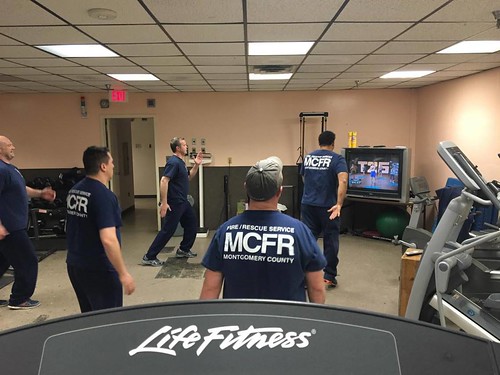
Since my rehab process has been a team approach, I asked that two individuals who have played a role in my recovery be included in the interview. Dr. Jill Captain, of the MCFRS Fire and Rescue Occupational Medical Services (FROMS) section, is leading the way for better screening tools for any firefighter over age 40 who may be at risk. As well, Firefighter/Paramedic Katie Dennison (Fire Station 1-C Shift) is very involved in firefighter wellness, has a Masters in exercise physiology and works part time at Suburban Hospital's cardiac rehab unit where I am doing my rehab.
In addition, MCFRS Fire Chief Scott Goldstein has plans to bring together some of the MCFRS personnel who have also experienced cardiac events for a videotaped round table to highlight the issue within the department.
I am very hopeful that the information shared in both projects will help reduce cardiac deaths in the fire service. More to come.
 |
| Firefighter Roger Marks |
 |
| Firefighter/Paramedic Katie Dennison being interviewed |