Showing posts with label hotel safety. Show all posts

Tuesday, August 1, 2017

It’s National Night Out – make sure we find you in an EMERGENCY!


National Night Out is a premier community-building event in the County. Do you know the police officers who work to keep your neighborhood and your family safe? Come out to the many National Night Out events being celebrated around the County and meet the first responders that serve your community and on your way home --- check your house numbers and make sure they are visible. 

In an emergency, police, fire and rescue workers depend on house numbers to find YOU as quickly as possible. Finding your home - especially at night - can be challenging if address numbers are unreadable, hidden, unlighted or have missing numbers and may delay emergency responders from getting to you as quickly as possible.
Are your house numbers visible from the street? Are they set on a background of contrasting color? If your house is hidden from the street, are your numbers attached to a visible fence, mailbox or gate? Is your mobile home identified with your house number? If you live on a corner, does your house number face the street named in your address?
If you've answered "no" to any of these questions, please follow the guidelines below to make sure your house number is easy to read:

1. Numbers must be visible from the street. Existing residential home numbering can be 3 1/2 inches high, however new residential homes must be at least 5 inches high and if you replace existing numbers they must be at least 5 inches high.

2. Numbers should be placed on a contrasting background, with a reflective coating on the numbers for easy visibility at night.

3. Repair or replace aging address number placards, especially on mailboxes that are a distance from the front of the residence.

4. Prune any bushes, tree limbs or other growth that has covered your house numbers.

5. Numbers should be placed on or beside the front door. If your door is not easily seen from the street, put the numbers on a post, fence or tree at the driveway entrance so they can be clearly seen from the street. In addition to numbers on the front door of your house, if you have a rural-style mailbox, reflective and contrasting numbers should be placed on both sides of the box so they can be seen by an emergency vehicle approaching from either direction.

Montgomery County Code on Addresses
a.The owner of any structure presently existing or constructed in the future must display Arabic numbers designating the address assigned to the structure by the Maryland-National Capital Park and Planning Commission, or by the municipality in which the structure is located. Numbers must be at least five (5) inches high for single-family detached and attached residences and at least six (6) inches high for commercial, industrial or multifamily structures. However, if the numbers designating the address of a single-family residence on April 5, 1988, were at least three (3) inches high, those numbers comply with the size requirement of this section as long as they remain in place. Address displays must be posted on a contrasting background displayed in a conspicuous place that is unobstructed and clearly readable from the street named in the official address of the structure. Where a structure has more than one (1) address or where more than one (1) structure shares a common entry or driveway, numbers must designate the addresses in sequence.

b. An agency of the county must not require a permit for a sign containing only the address of a residence if the sign is smaller than a maximum size set by the county executive by regulation.


Tuesday, July 19, 2016

Going Out Of Town? Do Not Take A Vacation From Fire Safety!

Getting ready to go out of town? The summer months are not the time to take a vacation from fire safety. Be sure to check your home before leaving to minimize the risk of fire while you are away and review these important safety tips:
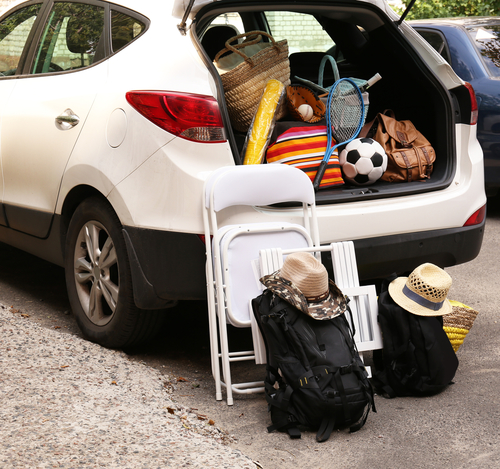
photo of car with beach items getting ready to be loaded in the back

Your Home

  • All stoves and electrical appliances should be turned off or disconnected.
  • Unplug all television sets, computers and radios. Lightning storms or sudden electrical surges can damage or even cause a fire in these types of equipment.
  • When you return, check to make sure all smoke alarms are working.
  • Tell a trusted neighbor your departure and return dates. Supply an itinerary with phone numbers where you can be reached in the event of an emergency.

If You Are Staying In A Hotel/Motel

When you are traveling away from home and staying in a hotel or motel, it is important to know what actions to take in the event of a fire. While hotel fires account for only a small number of fire fatalities, they present a unique fire risk. Fire can spread quickly in hotels and guests are typically in unfamiliar surroundings. While sprinklers, smoke alarms and fire walls are required in many parts of the world, do not assume that all hotels will have the same safety features you may be accustomed to. The more you know in advance about dealing with a fire emergency, the better your chances for survival:

  • Select a hotel/motel that, at a minimum, has smoke alarms installed. It is recommended to select lodging that also has a fire sprinkler system installed. If you must stay in a hotel/motel without alarms or sprinklers, or have mobility limitations, request a room on the first or second floor.
  • When you arrive, review the fire safety information provided. It is typically posted near or on the back of the entry door. Just like in your home, you need to plan your escape ahead of time. Locate the two exits nearest your room. Walk the potential escape routes, counting the number of doors between your room and the exit. Make sure that the fire exit doors work and are unlocked. In a real fire, the hallway may become dark with smoke making it hard to see.
  • Put your room key, flashlight, cell phone, eyeglasses and shoes, near the bed. You don't want to waste any time looking for things during a fire and keeping everything together can make your escape easier.
  • Learn what number to call in the event of an emergency - not all locations use 9-1-1.

Tuesday, August 11, 2015

Vacation Fire Safety

Getting ready to go out of town? Holidays and the summer months are not the time to take a vacation from fire safety. Be sure to check your home before leaving to minimize the risk of fire while you are away and review these important safety tips:

Your Home

  • All stoves and electrical appliances should be turned off or disconnected.
  • Unplug all television sets, computers and radios. Lightning storms or sudden electrical surges can damage or even cause a fire in these types of equipment.
  • When you return, check to make sure all smoke alarms are working.
  • Tell a trusted neighbor your departure and return dates. Supply an itinerary with phone numbers where you can be reached in the event of an emergency.

If you are staying in a hotel/motel

When you are traveling away from home and staying in a hotel or motel, it is important to know what actions to take in the event of a fire. While hotel fires account for only a small number of fire fatalities, they present a unique fire risk. Fire can spread quickly in hotels and guests are typically in unfamiliar surroundings. While sprinklers, smoke alarms and fire walls are required in many parts of the world, do not assume that all hotels will have the same safety features you may be accustomed to. The more you know in advance about dealing with a fire emergency, the better your chances for survival.
  • Select a hotel/motel that, at a minimum, has smoke alarms installed. It is recommended to select lodging that also has a fire sprinkler system installed. If you must stay in a hotel/motel without alarms or sprinklers, or have mobility limitations, request a room on the first or second floor.
  • When you arrive, review the fire safety information provided. It is typically posted near or on the back of the entry door. Just like in your home, you need to plan your escape ahead of time. Locate the two exits nearest your room. Walk the potential escape routes, counting the number of doors between your room and the exit. Make sure that the fire exit doors work and are unlocked. In a real fire, the hallway may become dark with smoke making it hard to see.
  • Put your room key, flashlight, cell phone, eyeglasses and shoes, near the bed. You don't want to waste any time looking for things during a fire and keeping everything together can make your escape easier.
  • Learn what number to call in the event of an emergency - not all locations use 9-1-1.

If the alarm does sound:

  • If you feel conditions in the hallway are safe, go to your nearest exit and proceed downstairs to the first floor and exit the building. Make sure to close all doors behind you as you exit.
  • Be sure to take your room key. In some cases, your room may end up being the safest place to be and you may need to return if your exit is blocked.
  • If there is any smoke in the hallway, crawl low - under smoke - to the fire exit and safety.
  • If a fire starts in your room, leave immediately and close the door behind you to confine the fire and smoke to the room. Activate the fire alarm and call the fire department once you are safely out of danger.
  • NEVER use an elevator under fire conditions. Elevators may malfunction, cables could melt, the elevator car may heat up to lethal temperatures or open on the floor where the fire is. Always take the stairs when exiting from a high-rise building.
Every fire is different. While these guidelines may help you survive a fire, there are situations where you will need to do things differently. Taking the time to prepare in advance can save your life.