Showing posts with label Operational Readiness. Show all posts

Monday, July 25, 2016

Maintaining Operational Readiness

By: Captain John Emmons
       Fire Station 31-A Shift

There is more to a career firefighter's day than responding to emergencies. We also have to maintain our apparatus and equipment to ensure they are ready and will operate when needed the most.

For example, every three months, we complete a detailed maintenance of the ladder on our ladder truck here at Rockville Fire Station 31. This is actually completed on all ladder trucks in the county.

To be done properly, a detailed and lengthy process is required. The first step is to remove the old grease from the ladder. Over time and use, it loses its ability to lubricate and protect the ladder as it is extended and retracted. It is imperative to get off all the old.

The next step is to wash the ladder. A wash brush does not do a very good job so we wash it by hand with a rag, soap and water. After the ladder is dry, it's time to apply a thin coat of fresh, clean grease. The entire process takes several hours and is necessary to keep the ladder operating safely and properly.

Below are some photos from our quarterly aerial cleaning and lubrication we recently competed at station 31.
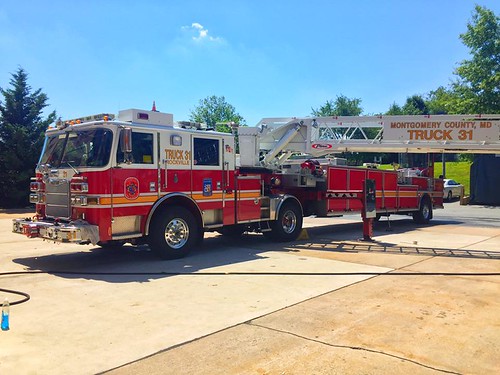
photo of firefighters performing maintenance on ladder trucks ladder

Friday, April 22, 2016

Ensuring Operational Readiness

By: Firefighter/Paramedic Joe Crum
       Fire Station 17, A-Shift

The northern part of Montgomery County can be considered very rural. Large farming areas exist in towns such as: Poolesville, Hyattstown, Damascus, and Laytonsville. A fire in an old farm houses or large barns create different challenges for a fire department compared to what we will see in an urban/city environment.

The biggest challenge we face in these areas is water supply. In these areas, municipal water services may not be available and with that, no hydrants to supply the fire engine to attack a fire if it occurs. Because fire does not go out without water, we need to find water somewhere else.

Throughout the county, we can find dry hydrants or cisterns to get the water we need. A dry hydrant is usually a piece of pipe that extends from a body of water, typically a lake or pond, and allows one Engine Company to pull water from it so it can fill Tankers that then take water to the scene of a fire. Cisterns are large underground tanks that hold thousands of gallons of water. These may have a pipe sticking out of the ground, similar to a dry hydrant, or could just be a removal cover that we can place suction hose directly into the water and pull the water into the fire engine.

Every firehouse in the county keeps record of where a dry hydrant or cistern is located within their coverage area. These sites are inspected and tested on a quarterly basis by station crews. We make sure that they are accessible and functional. The property owner is still responsible for maintenance. As a resident it is very important to keep these clear and not block access by any vehicles. Easy access for us could mean a big difference at a fire.

Below is a picture of Engine 717 from Laytonsville testing a cistern in their area.

a picture of Engine 717 from Laytonsville testing a cistern in their area