By: Roger A. Marks, Firefighter
February is Heart month and every year Glen Echo's swing dance community, through the efforts of Flyingfeet Enterprises, hosts the "Red Dress Ball" dance that benefits the American Heart Association and women's cardiac health issues.
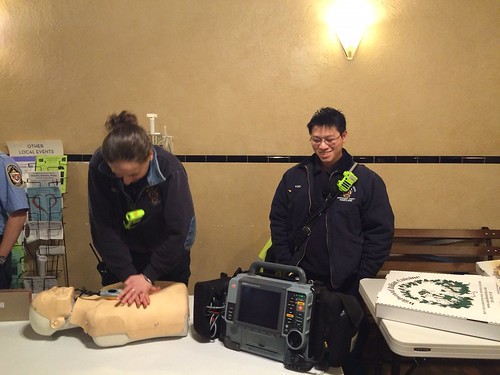
This year MCFRS Community Outreach (CO) added something new for the dance community to think about. As a follow-up to Trish Thompson's I-Team 4 series of Automatic External Defibrillator (AED) stories the CO team was joined by crews from Bethesda-Chevy Chase Rescue Squad and Glen Echo Fire Department to offer dancers insight into the chain of survival via High Performance CPR and public access AED's.
The historic Spanish Ballroom, where the event was held, is part of the National Park Service (NPS) and has an AED available to occupants that is maintained by the NPS. Approximately 325 people were in attendance this year including staff and volunteers.
In addition, the public was introduced to Glen Echo's new Paramedic chase car (ALS711) staffed by PMIC Danny Kuan, and Firefighter Meghan Quinn. Ambulance 741 had a crew of 3 including Driver Craig Pernick, Charge EMT Jordan Hoefler, and Acting Active Derek Schlickeisen.
Participants were also treated to a demonstration of the Lucas Device which is a battery operated mechanical piston that delivers flawless chest compressions during CPR. While the participants watched this technology effortlessly perform compressions, they also had an opportunity to try their hand at manual compressions with visual feedback from Physio-Control's True-CPR device. Everyone came to understand just how hard it is to maintain good chest compressions for CPR. MCFRS CO had approximately 100 people engage directly with the on hand Fire-Rescue personnel or try the hands-on activity.
Staff also had Files of Life on hand as well as information about the Alert Montgomery system. Photos from the event are below.
Showing posts with label women and heart attacks. Show all posts
Wednesday, February 17, 2016
Friday, February 6, 2015
Signs and Symptoms of Heart Attacks
A heart attack is a life-and-death emergency and every second counts. If you experience or see someone with any of the listed symptoms, immediately call 9-1-1. Not all these signs occur in every heart attack. Sometimes they go away and return. Heart attack victims can benefit from new medications and treatments unavailable to patients in years past. For example, clot-busting drugs can stop some heart attacks and strokes in progress, reducing disability and saving lives. But to be effective, these drugs must be given relatively quickly after heart attack or stroke symptoms first appear. So again, don't delay-get help right away! Call 9-1-1.
Some heart attacks are sudden and intense, but most heart attacks start slowly, with mild pain or discomfort. Often people affected aren't sure what's wrong and wait too long before getting help. Here are signs that can mean a heart attack is happening:
- Chest discomfort:
- Most heart attacks involve discomfort in the center of the chest that lasts more than a few minutes, or that goes away and comes back. It can feel like uncomfortable pressure, squeezing, fullness or pain.
- Discomfort in other areas of the upper body:
- Symptoms can include pain or discomfort in one or both arms, the back, neck, jaw or stomach.
- Shortness of breath:
- May occur with or without chest discomfort.
- Other signs:
- These may include breaking out in a cold sweat, nausea or lightheadedness
As with men, women's most common heart attack symptom is chest pain or discomfort. But women are somewhat more likely than men to experience some of the other common symptoms, particularly shortness of breath, nausea/vomiting, and back or jaw pain.
If you or someone with you has chest discomfort, especially with one or more of the other signs, don't delay -call 9-1-1 immediately.
Subscribe to:
Posts (Atom)