Showing posts with label american heart association. Show all posts

Friday, June 17, 2016

The “FAST” Track to Saving Lives

graphic of an ambulance that lists signs of stroke. List is also below in wording in article


A stroke is always a medical emergency. Recognize the signs of stroke and call 911!


A stroke happens when the supply of blood to the brain is suddenly interrupted. Some strokes are fatal while others cause permanent or temporary disability. The longer a stroke remains untreated, the greater the chance of stroke related brain damage. Emergency medical treatment soon after symptoms begin improves the chance of survival and successful rehabilitation.

A blood clot blocks an artery (a blood vessel that carries blood from the heart to the body) or a blood vessel (a tube through which the blood moves through the body) breaks, interrupting blood flow to an area of the brain. When either of these occur, brain cells begin to die and brain damage occurs. When brain cells die during a stroke, abilities controlled by that area of the brain are lost. These abilities include speech, movement and memory. How a stroke patient is affected depends on where the stroke occurs in the brain and how much the brain is damaged.
Stroke is the fourth leading cause of death in America and the Number One cause of adult disability.
Stroke Warning Signs
The American Stroke Association says these are the warning signs of stroke:
  • Sudden numbness or weakness of the face, arm or leg, especially on one side of the body.
  • Sudden confusion, trouble speaking or understanding.
  • Sudden trouble seeing in one or both eyes.
  • Sudden trouble walking, dizziness, loss of balance or coordination.
  • Sudden, severe headache with no known cause.
Stroke Symptoms
If you or someone with you has one or more of these signs, don't delay! Immediately call 9-1-1. Also, check the time so you'll know when the first symptoms appeared. It is very important to take immediate action. If given within three hours of the start of symptoms, a clot-busting drug can reduce long-term disability for the most common type of stroke.
If you have experienced any of these symptoms, you may have had a TIA (Transient Ischemic Attack) or mini-stroke, consult your doctor immediately. If you think someone may be having a stroke, act F.A.S.T. and do this simple test:
Act F.A.S.T.
FACE - Ask the person to smile. Does one side of the face droop?
ARMS - Ask the person to raise both arms. Does one arm drift downward?
SPEECH - Ask the person to repeat a simple sentence. Are the words slurred? Can he/she repeat the sentence correctly?
TIME - If the person shows any of these symptoms, time is important.

Call 911 and get to the hospital immediately. 

Thursday, March 17, 2016

Hands Only CPR Demo

Yesterday morning, live on #Periscope, Capt. Bob Lindsey showed us how to perform hands only CPR. Take a few minutes to learn something new!


Friday, February 19, 2016

Back From the Dead: AEDs Can Save Your Life

February is Heart Month. As part of that, we partnered with NBC4 on a recent story they did about Automatic External Defibrillators (AED's).

Below are two related videos. One is from the piece that appeared on NBC4 while the other shows you how you would use an AED.

You can also go to the NBC4 website to view and read: Back From the Dead: AEDs Can Save Your Life - If You Can Find Them


Wednesday, February 17, 2016

Glen Echo's Annual Red Dress Ball Has Heart

By: Roger A. Marks, Firefighter

February is Heart month and every year Glen Echo's swing dance community, through the efforts of Flyingfeet Enterprises, hosts the "Red Dress Ball" dance that benefits the American Heart Association and women's cardiac health issues.

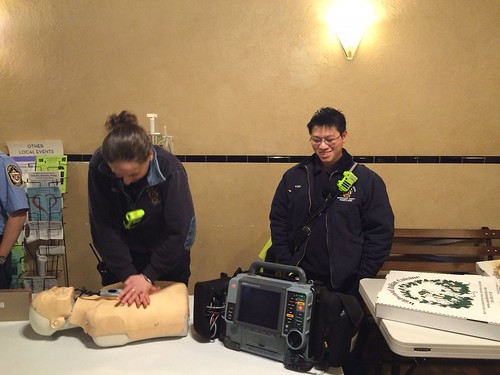
This year MCFRS Community Outreach (CO) added something new for the dance community to think about. As a follow-up to Trish Thompson's I-Team 4 series of Automatic External Defibrillator (AED) stories the CO team was joined by crews from Bethesda-Chevy Chase Rescue Squad and Glen Echo Fire Department to offer dancers insight into the chain of survival via High Performance CPR and public access AED's.

The historic Spanish Ballroom, where the event was held, is part of the National Park Service (NPS) and has an AED available to occupants that is maintained by the NPS. Approximately 325 people were in attendance this year including staff and volunteers.

In addition, the public was introduced to Glen Echo's new Paramedic chase car (ALS711) staffed by PMIC Danny Kuan, and Firefighter Meghan Quinn. Ambulance 741 had a crew of 3 including Driver Craig Pernick, Charge EMT Jordan Hoefler, and Acting Active Derek Schlickeisen.

Participants were also treated to a demonstration of the Lucas Device which is a battery operated mechanical piston that delivers flawless chest compressions during CPR. While the participants watched this technology effortlessly perform compressions, they also had an opportunity to try their hand at manual compressions with visual feedback from Physio-Control's True-CPR device. Everyone came to understand just how hard it is to maintain good chest compressions for CPR. MCFRS CO had approximately 100 people engage directly with the on hand Fire-Rescue personnel or try the hands-on activity.

Staff also had Files of Life on hand as well as information about the Alert Montgomery system. Photos from the event are below.


Glen Echo's Annual Red Dress Ball Has Heart

Friday, May 8, 2015

Learn About CPR

Great job by Captain Triplett, Master Firefighter/Paramedic Russell, and Firefighter Richardson.

Wednesday, February 2, 2011

What You Should Know About Your Blood Pressure

According to the American Heart Association, nearly one in three U.S. adults has high blood pressure. Because there are no symptoms, nearly one-third of these people don’t know they have it. 

Please take a moment to look over the below fact sheet!  Help us to help you live a healthy life and possibly avoid having to call 9-1-1 one day due to medical issues associated with High Blood Pressure!