Showing posts with label power restoration. Show all posts

Monday, March 28, 2016

Don’t Get Blown Away By Wind Related Issues

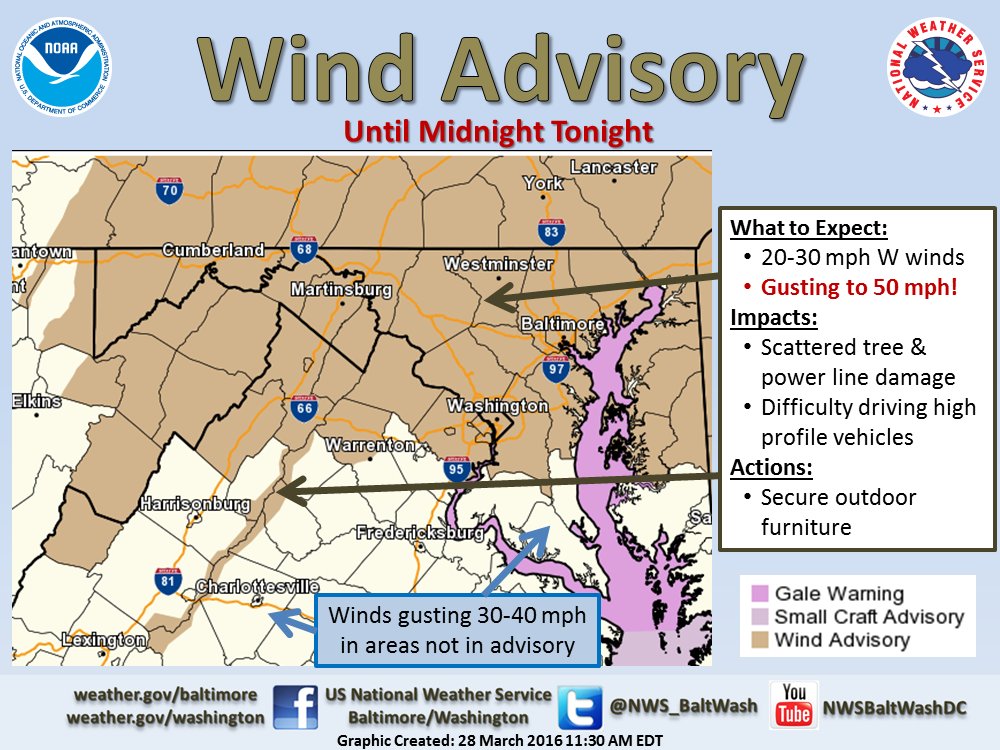
As of noon, Montgomery County is under a Wind Advisory through at least midnight tonight. Winds are expected to be 20 – 30 mph with wind gusts as strong as 50 mph!

The strongest winds are expected to occur around now and also later today and through this evening.

With winds like that you can potentially expect to see scattered tree damage along with downed power lines. Of course with downed power lines you can also expect power outages.

MCFRS would like to provide the following tips and are asking residents to plan ahead, be ready and be safe during this wind event:
  • Make sure you secure, or bring inside, any loose items that could become dangerous projectiles in high winds.

  • Ensure your cell phones, laptops, tablets and other important devices are fully charged.

  • Do NOT use candles for lighting. Using candles during a power outage poses an extreme risk of fire. Use flashlights or battery-powered lighting options. 

  • As a reminder, treat ALL intersections without a working stoplight as a four-way stop.  

  • Turn off any heat-producing appliances (toaster oven, range, irons, etc.) that were running when the power went out to prevent them from starting unexpectedly when power is restored.  If left on, they can pose a serious fire hazard.  

  • If you are using a generator, make sure it is in a well-ventilated area to reduce the risk of breathing harmful fumes. Never place a generator under an open window and follow all manufacturer instructions.

  • Make sure the batteries in your smoke alarm and carbon monoxide alarm are fresh. Test alarms to ensure they are working.  

  • Take care driving high profile vehicles such as semi-trailer trucks, buses, and sport utility vehicles. 

  • If live wires are involved, the tree is blocking a roadway, the tree is on a structure or if anyone is trapped under a fallen tree, call 911.

  • Keep children and pets away from areas where power lines may have fallen.

  • Use extreme caution when cleaning up storm damage on your property. Downed or damaged power lines can send electrical currents through tree branches and metal fences, so survey the area carefully - especially if you'll be using a pruning pole, ax or chainsaw. 

  • Do not remove fallen tree limbs or other debris from power lines. Tree limbs and other objects can conduct electricity and carry a current strong enough to cause serious injury or death.

  • Use extreme caution around downed or damaged power lines. Do not remove fallen tree limbs or other debris from power lines, never drive over downed lines and treat all wires – even those that are hanging or down – as if they are “live” (energized).

  • For downed trees on public property, Montgomery County residents should call -311 between 7 a.m. and 5 p.m. weekdays (or 240-777-0311 from outside the county or from a cell phone), or file a report at http://www.montgomerycountymd.gov/311

  • Reach out to your neighbors who may need help, especially those that are elderly, disabled or infirmed.


Saturday, January 23, 2016

Safe Use of Portable Generators

More and more Montgomery County residents are using portable generators when the power goes out. Across the region and country,Carbon Monoxide (CO) deaths associated with generators have spiked in recent years as generator sales have risen. 


If you have a generator, or know someone who does, please take a moment to read the below tips and pass them along to friends and family who may own one as well.  These tips are courtesy of our partners in safety at the NFPA.
  • Generators should be operated in well ventilated locations outdoors away from all doors, windows and vent openings.
  • Never use a generator in an attached garage, even with the door open.
  • Place generators so that exhaust fumes can’t enter the home through windows, doors or other openings in the building.
  • Make sure to install carbon monoxide (CO) alarms in your home. Follow manufacturer’s instructions for correct placement and mounting height.
  • Turn off generators and let them cool down before refueling. Never refuel a generator while it is running.
  • Store fuel for the generator in a container that is intended for the purpose and is correctly labeled as such. Store the containers outside of living areas.

Tuesday, July 3, 2012

Update: 140 Intersections Without Working Stoplights; A Partial Listing of Primary Intersections


Update from Alert Montgomery.

As of 5:00AM, there are approximately 140 intersections without working stoplights in Montgomery County. As a reminder, treat ALL intersections without a working stoplight as a four-way stop.  
 
-Allow extra time for your commute and plan on delays.  
-Ride-On is reporting that 13 routes are on detour.
-Proceed with caution ONLY when traffic permits.  
-Enter intersections only when it is safe to do so, using turn signals to let other motorists know your intentions.  
-Yield to pedestrians in crosswalks.  
-Be alert for police officers directing traffic.  
 
A partial listing of primary intersections without working stoplights include:  
 
-Cabin John Pkwy & Mac Arthur Blvd  
-Columbia Blvd & Georgia Ave(MD97) & Seminary Rd  
-Forest Glen Rd(MD192) & Georgia Ave(MD97)  
-Little Falls Pkwy & River Rd(MD190)  
-Old Georgetown Rd(MD187)  from Tuckerman Lane to Democracy Blvd
-E Gude Dr & Frederick Rd(MD355) & W Gude Dr
-Falls Rd & Wootton Parkway


Tell others about Alert Montgomery! Have them sign-up for this free county service at https://alert.montgomerycountymd.gov

Monday, July 2, 2012

Update: 240 Intersections w/o Traffic Lights; Partial List of Primary Intersections w/o Working Stoplights

From ALERT MONTGOMERY below: 


Approx. 240 Intersections w/o Traffic Lights; Obey 4-Way Stop Rules and Drive with Caution. 

As of 5:30AM, there are approximately 240 intersections without working stoplights in Montgomery County. As a reminder, treat ALL intersections without a working stoplight as a four-way stop.

-Allow extra time for your commute and plan on delays.
-Proceed with caution ONLY when traffic permits.
-Enter intersections only when it is safe to do so, using turn signals to let other motorists know your intentions.
-Yield to pedestrians in crosswalks.
-Be alert for police officers directing traffic.

A partial listing of primary intersections without working stoplights include:

-Connecticut Ave(MD185) & Randolph Rd
-Connecticut Ave(MD185) & Veirs Mill Rd(MD586)
-Cabin John Pkwy & Mac Arthur Blvd
-Colesville Rd(US29) & University Blvd E(MD193) (Four Corners)
-Columbia Blvd & Georgia Ave(MD97) & Seminary Rd
-Forest Glen Rd & Forest Glen Rd(MD192) & Georgia Ave(MD97)
-Jones Bridge Rd & Rockville Pike(MD355)
-River Rd(MD190) & Wilson Ln(MD188)
-Little Falls Pkwy & River Rd(MD190)
-Democracy Blvd & & Old Georgetown Rd(MD187)
-E Gude Dr & Frederick Rd(MD355) & W Gude Dr

Sent to Montgomery County Severe Traffic (24 hrs), Montgomery County Severe Traffic 6am-10am/3pm-8pm (E-mail accounts, Cell phones) through Alert Montgomery

Saturday, June 30, 2012

After The Storm Tips

1. Listen to the authorities. Remain indoors until an official "all clear" is issued.

2. 
Use extreme caution when cleaning up storm damage on your property. Downed or damaged power lines can send electrical currents through tree branches and metal fences, so survey the area carefully - especially if you'll be using a pruning pole, ax or chainsaw.


3.
 For downed trees on public property, Montgomery County residents should call -311 between 7 a.m. and 5 p.m. weekdays (or             240-777-0311       from outside the county or from a cell phone), or file a report at http://www.montgomerycountymd.gov/311. If live wires are involved, the tree is blocking a roadway, the tree is on a structure or if anyone is trapped under a fallen tree, call 911.

4
Know your limits. Many storm-related deaths and injuries involve existing health problems exacerbated by the physical demands of cleanup activities.

5.
 Drive with caution. Avoid areas subject to flooding, including low spots, canals and streams. Do not attempt to drive on a flooded road, which could lead to becoming stranded or trapped because the depth of the water and the condition of the road is not always obvious.

6. Be especially cautious at night when it is harder to recognize flood dangers, downed wires and other hazards.


7. 
Call 911 for life threatening situations only.

8. 
Call authorities to report any hazards such as downed power lines, leaking gas mains, broken water mains and overturned gas tanks.

9.  
Watch what you eat. If power was off during the storm, check refrigerated and frozen foods for spoilage. When in doubt, throw it out.

10. Avoid areas subject to flooding, including low spots, canals and streams. Never attempt to drive on a flooded road.  

11.  
Replenish supplies used from your emergency kit as soon as possible, you might need it again next week. 
12. Check on your neighbors - especially the elderly, those with special needs or the disabled.