Showing posts with label snowpocolypse. Show all posts

Monday, February 8, 2016

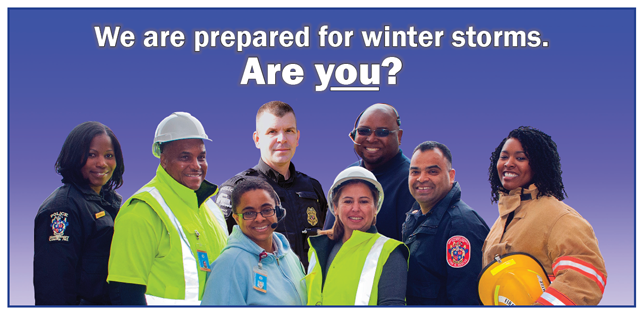
Three Things You Need To Do To Get Ready For Snow Storm

Three things you need to do to get ready 
for seasonal storms and emergencies:

1. Sign up for Alert Montgomery.
2. Keep these Phone Numbers handy.
Visit montgomerycountymd.gov/snow for more information.

Friday, January 22, 2016

SNOW - Stay off the Roads, Not Out in the Weather

The storm is fast approaching! Please heed the warnings and stay off the roads starting early this afternoon.

Overall, most winter storm deaths result from vehicle or other transportation accidents caused by ice and snow. Residents should avoid driving when conditions include sleet, freezing rain or drizzle, snow, or dense fog. These are serious conditions that are often underestimated, and they make driving – and even walking outside – very hazardous.
It is safer for everyone if you stay put – and not travel during inclement weather – whether you are at home, work or school.

By staying off the roads during the worst of the weather, local departments of transportation are more easily able to access roads that need treatment, snow plows can more freely clear roads and get to areas needing plowing and public safety officials can respond more quickly to residents in need of emergency services.

It may require employees to take a couple of hours of personal leave during the winter, but leaving early enough to avoid bad weather and traffic gridlock caused by slippery road conditions is worth the investment. Thinking strategically about your travel and where you really need to be will require some planning and thought.

“Get Where You Need to be Before the Weather Gets Bad”

Do NOT Travel During Winter Storms

    SNOW - Stay off the roads Not Out in the Weather
  • Curtail “elective” travel; avoid unnecessary travel. If it is not a life safety issue, stay off the roads.
  • If you don’t have to travel… don’t! The safest place during a winter storm is indoors. About 70 percent of deaths related to ice and snow occur in automobiles.
  • Stay at the office an extra hour, or leave early, to avoid travel during a winter storm.
  • If residents stay off the roads during a storm, transportation workers and public safety officials are better able to clear roadways and respond to emergency needs quicker.
Weather Changes Quickly
  • Be prepared for the worst. Be ready to spend an extra hour at the office, or leave an hour or two early, to avoid a more time consuming commute home during the height of a storm.
  • Have an emergency supply kit in your office and car.
Listen to Local Officials
  • If local officials advise residents to stay off the roads – then stay off the roads.
  • Public safety and emergency management officials, along with National Weather Service meteorologists, base travel advisories and guidance on weather forecasts. Heed their advice!
  • Businesses that follow closing/delay policies from local jurisdictions or the federal Office of Personnel Management need to monitor those sources and release employees when advised.
Monitor the Weather
  • Listen to local Radio/TV weather forecasts; monitor social media.
  • Sign up for text alerts from your local government.
  • Sign up for weather alerts from NOAA/National Weather Service, including RSS feeds of your forecast and weather watches/warnings.
  • Purchase a NOAA weather radio for your home and office. NOAA Weather Radio is the prime alerting and critical information delivery system of the National Weather Service (NWS). NOAA Weather Radio broadcasts warnings, watches, forecasts, and other hazard information 24 hours a day.
Know the Emergency Plans for your Children’s School
  • If your child is safe at school, why risk a traffic accident during the worst weather to reach him/her, and then put all of you in danger? Let the school system implement their emergency plan, stay off the road and let transportation crews clear the roadways.

About the National Capital Region (NCR)

The National Capital Region (NCR) is not an operational entity because emergency response is a local function. Because the NCR is a collection of sovereign jurisdictions, including cities, counties, states and the District of Columbia, this website and the efforts of the region's communicators and public information officers will focus on regional collaboration between the region’s homeland security partners to achieve a “safe and secure National Capital Region.”

Wednesday, January 20, 2016

Three Things You Need To Do To Get Ready For Snow Storm

Three things you need to do to get ready 
for seasonal storms and emergencies:

1. Sign up for Alert Montgomery.
2. Keep these Phone Numbers handy.
Visit montgomerycountymd.gov/snow for more information.

Tuesday, May 11, 2010

What's Brewin With Assistant Chief Scott Graham


Assistant Chief Scott Graham appeared recently on County Cable’s “What’s Brewin” program to provide insight into Fire and Rescue’s Operations during the big snow storms just a few short months ago.

Saturday, February 13, 2010

NEWS ADVISORY - Winter Safety Tips


The Montgomery County Fire and Rescue Service reminds residents of the dangers present with snow piles. With the recent record-breaking snow storms, roadside, driveway and cul-de-sac snow piles are getting bigger, but should remain off limits to children.


Children like to dig tunnels or build forts in piles of snow created by snow plows, but children risk becoming trapped by collapsing snow forts. Unstable walls and tunnels may collapse, trapping and burying a child inside. The weight of the snow collapsing on top of a child can quickly hinder their breathing, making it difficult to call for help and virtually eliminating their chances of self-rescue. The best place for children to play is under close adult supervision.

Additionally, Fire Chief Richard Bowers is asking residents to continue to clear snow from fire hydrants. The record-breaking snow accumulation combined with the after-effects of plowing roads and parking lots have left many fire hydrants partially or completely buried in snow. By keeping fire hydrants clear of snow, the public can help firefighters easily locate them and access water quickly, preserving valuable time to potentially save lives and structures.

If you have a hydrant on or near your property, please take a few minutes to clear away the snow. If you cannot clear the hydrant, please ask a neighbor or someone else who can do it for you. Remember, quick access to fire hydrants benefits everyone. Other safety reminders:

• Pedestrians should wear brightly colored clothing so drivers can see you, especially in times of poor visibility, and use reflective clothing or stickers for maximum visibility.

• Never go out on frozen ponds, lakes or creeks. It's impossible to judge the strength of ice by its appearance, thickness, daily temperature, or snow cover alone. Ice strength is also dependent on water depth under the ice, the size of the water and water chemistry, currents and distribution of the load on the ice. The only safe ice is at the skating arena.

• Ensure your house numbers are visible and can be easily seen. Do this at night time as well.

Friday, February 12, 2010

Danger May Lurk Above!


Well, I hope everyone is starting to get back to normal out there! I actually drove into work today!

As I was out and about, I noticed a potentially dangerous situation that may be an issue for the next several days and wanted to make all of your aware. The amount of snow on the roofs of homes and businesses has created a whole new hazard that has nothing to do with them caving in or collapsing.

The danger is from large chunks of snow or ice falling from above a hitting people, or pets, down below.

My photos above and to the right of this posting illustrate a couple of examples of the dangers. The top photo shows the front of a house with very large icicles dangling from above. I have seen even larger chunks in other places! Bottom line, they can detach and fall and can inflict fairly serious injuries to an unsuspecting person below. I took the opportunity to utilize a telescoping pole to knock the icicles off from the ground – from a safe distance.

I do not recommend you climb a ladder and get on your own roof to remove these hazards!

Likewise, the photo to the right shows a typical shopping center in the Washington-Metro area and you can see where snow has already fallen from the roof with one chunk starting to teeter on the edge. Fortunately, this particular store recognized the danger and you can also cones around that diverts people away from the danger zone.

So as you make your way about today, and for the next several days, be aware of what is going on above you. Look out for falling snow chunks or icicles!

As always - stay safe!

Bill Delaney

Wednesday, February 10, 2010

Update

Here is some important information. Consult the County website at www.montgomerycountymd.gov for updates.


Useful phone numbers:

Emergencies and to report "hot" or sparking wires, especially those across roadways, call 9-1-1 (do not use for plowing questions);

Non-emergency, Police 301-279-8000;

Snow removal problems or downed trees 240-777-6000; email highway@montgomerycountymd.gov;

Power outages, call your power provider: PEPCO at 1-877-737-2662, Allegheny Power at 1-800-255-3443 or Baltimore Gas and Electric at 1-877-778-2222;

Four-wheel drive volunteers 240-777-2600; email volunteer@montgomerycountymd.gov

Shelter information/transportation 240-777-6000;

Damaged mailboxes (standard boxes) report 240-777-6000; damaged non-standard mailbox, call 240-777-8920

Residents concerned about the safety and well-being of children, elderly individuals or adults with disabilities, call the County's Crisis Center 240-777-4000.

Web sites:

County plowing policies and plans (pdf).

street missed by County plows, the County's Snow Operations.

general snow information, www.montgomerycountymd.gov.

Shelters:

Richard Montgomery High School, 250 Richard Montgomery Dr. in Rockville, remains open. Transport to the center is being handled by volunteers with four-wheel drive vehicles and by Maryland National Guard members.

Gwendolyn E. Coffield Community Center, 2450 Lyttonsville Rd., Silver Spring and Seneca Valley High School, 19401 Crystal Rock Dr., Germantown.

Sign up for Alert Montgomery to have emergency alerts, notifications and updates sent to your cell phone, e-mail, PDA, Twitter or Facebook.

Region’s Fire Chiefs Encourage Residents to Take Safety Measures as New Winter Storm Arrives

News Highlights

• Evacuate the building if you notice any of the warning signs of potential roof collapse. Call 9-1-1 if your roof collapses.

• Do not attempt to clear the snow off your roof; do clear downspouts and drains.

• Clear snow away from fire hydrants.

• Take precautions to prevent fires, including unplugging appliances after power outages.

As heavy snow continues to accumulate on flat roofs of buildings, the National Capital Region’s fire chiefs encourage residents to watch for the warning signs of a potential roof collapse. If your roof collapses, call 9-1-1.

Warning Signs of Potential Roof Collapse:

If they have a flat roof, homeowners should monitor the ceiling below the roof and look for the following signs of roof collapse:

• Sagging ceiling beneath the flat roof.

• New cracks on the ceiling drywall or plaster.

• Popping, cracking or creaking sounds.

• Doors and/or windows that can no longer be opened or closed.

Residents should evacuate their home if they notice any of these warning signs, and they should call 9-1-1 if their roof collapses. Homeowners should not try to clear snow off of their roof because they may slip and fall or hit electrical wires. However, residents should clear the areas around downspouts and roof drains so that water from melting snow can flow away from the house.

Most commercial buildings are designed to accommodate 24 inches of dense, compact or wet snow. If you notice any of the warning signs below, the building needs to be evacuated immediately:

• Sagging roof members, including steel bar joists, metal decking, wood rafters, wood trusses and plywood sheathing.

• Popping, cracking and creaking sounds.

•Sagging ceiling tiles and/or sagging sprinkler lines and sprinkler heads.

•Doors and/or windows that can no longer be opened or closed.

Roofs can fail for several reasons, including:

•Older buildings may not be designed to current standards and could be subject to problems.

•Roof drains and/or downspouts become blocked or frozen and melting snow or rain cannot adequately drain from the roof.

•Over time, additional weight is added to the roof, such as HVAC equipment or a new roof covering.

•Imbalance of snow load on roof (normally caused by drifting snow).

How to Protect Roofs After the Storm:

•Have a professional, licensed contractor remove all snow immediately from every roof surface, including roof overhangs and covered porches.

•Remove snow from side walls to prevent high snow mounds from pushing them in.

•Temporarily shore up and brace dipping or sagging roofs or walls.

•Verify that drains are clear of snow and ice to allow melting and runoff. If the roof is pitched and without drains, open paths to the eaves to ensure drainage and prevent ponding.

•Avoid ice dams by keeping the attic well ventilated, so snow doesn't melt and refreeze at the roof's edge. Also make certain the attic floor is well insulated to minimize the amount of heat rising from the house into the attic.

Clear Fire Hydrants and Vents After the Storm:

Clear snow away from all fire hydrants, so that they are easily visible in the event of a fire. Clear snow from heating and dryer vents to prevent possible carbon monoxide poisoning. Do not run generators in the home, garage, other enclosed spaces, or near exterior wall openings.

Fire Safety Tips to Follow:

•If the power goes out, turn off or unplug all appliances. When the electricity is back on, power surges can start fires. This safety precaution is especially important if computers, TVs and entertainment systems are not plugged into surge protectors.

•If the power is out, use flashlights, not candles. Candles can start fires.

•Don’t use gas or charcoal grills, propane heaters and stoves, kerosene space heaters or generators indoors because they can be fatal. Not only can these items start fires, but also they can cause carbon monoxide poisoning when used inside.

•Keep electric space heaters at least three feet away from anything flammable.

•If you are using a car to warm up, be sure the tail pipe is clear of snow or ice; a blocked tailpipe could cause carbon monoxide to leak inside your car. If you are warming up a car in a garage, make sure the garage door is open in order to prevent a build up of carbon monoxide.

•Discard fireplace ashes safely by putting them in a metal container away from the house. Ashes can stay hot for several days after a fire.

•Check the batteries in smoke alarms to make sure they are working. Have extra batteries on hand for a portable radio and flashlights.

•Make sure that all exits are snow free in case it’s necessary to evacuate the building in a fire.

•Watch out for downed power lines. Do not touch the wires or anything that the wires are touching. Contact your local utility and report the condition.

The National Capital Region — which is comprised of 11 local jurisdictions, two states and the District of Columbia — prepares for disasters collaboratively. This unique regional structure, in the area that is home to the nation’s capital with the associated elevated risks, requires an equally complex system to determine how to best and most equitably allocate scarce resources such as UASI funds.

The NCR’s elected officials, emergency management, law enforcement, fire and public health personnel, along with the nonprofit and private sectors, work together across the region’s jurisdictional boundaries to identify and prioritize projects to improve the region’s emergency preparedness and response capabilities.

###

About the National Capital Region The NCR encompasses the District of Columbia and parts of Maryland and Virginia, including the cities of Alexandria, Fairfax, Falls Church, Manassas and Manassas Park and the counties of Arlington, Fairfax, Loudoun, Prince William in Virginia and Montgomery and Prince George’s in Maryland, which include the municipalities of Bowie, College Park, Gaithersburg, Greenbelt, Rockville and Takoma Park.

Tuesday, February 9, 2010

How To Find Your Nearest Fire Hydrant

Many of you have been asking if there was a tool to find fire hydrants. 

Montgomery County map viewer allows you to enable the layer to show fire hydrant locations by clicking public safety, Fire rescue, Fire hydrant . Click on link below and follow the aforementioned instructions.

Montgomery County map viewer

Thanks to our Facebook friend Nicholas Belback for sorting this out!

Stay Safe!

Bill Delaney