Showing posts with label bike safety. Show all posts

Thursday, May 19, 2016

Bike To Work Day Friday. Use Your Head And Wear A Helmet!

Bike to work day announcement. Friday, May 20, 2016

Tomorrow is Bike to Work Day. MCFRS would like to remind all of you participating in this wonderful event to Use Your Head and Wear A Helmet!

According to the Insurance Institute for Highway Safety, Highway Loss Data Institute, helmet use has been estimated to reduce the odds of head injury by 50 percent, and the odds of head, face, or neck injury by 33 percent.

So, please enjoy Bike To Work Day safely! Our fire and rescue personnel do not wish to meet you by "accident" tomorrow!

More safety tips below from the University of Utah.


5 steps to cycling safety pictograph. various safety tips

Wednesday, July 16, 2014

MCFRS Captain Takes Two Silvers At Can-Am Police and Fire Games

Captain Penelope “Penny” Ingles has taken home two silver medals from the Can-Am Police and Fire Games.  The Games are an International Olympic style event that is held every two years.  This year York County, PA is hosting the 2014 Can-Am Police and Fire Games with the proceeds benefiting The Make-A-Wish Foundation.

Captain Ingles participated in the Chili Cook-Off taking away a silver medal. The judges thought the chili was excellent and it was a hands-down favorite of the non-judges. Penny also brought home Silver in the Mountain Biking event, which was held on Monday.

Way to go and congratulations!

Captain Ingles after getting Silver in Mountain Bike event

Good looking medal!!!
Captain Ingles was joined by her Mom for the Chili Cook Off


Tuesday, June 10, 2014

Kids and Bike Helmets: The Right Fit

Bike helmets are not optional equipment. A helmet is your last line of defense in an accident - never ride without one!
Kids should always wear helmets while biking
Helmets have been shown in studies to reduce the risk of head injury by 85 percent and the risk of brain injury by 90 percent. Nationally, only 15 percent of children bicyclists used bicycle helmets. Here are some points to consider when fitting a bike helmet on a child:
  • The helmet should sit on the child's head so that the front rim is just above the eyebrows. Use the two finger rule - leave about two fingers width between your eyebrows and the front of the helmet. If the helmet rests on the back of the head, the forehead, nose and chin will be exposed.
  • Before buckling the chin strap, have children shake their head from side to side. The helmet should generally stay put. If it moves excessively, it's too big and won't protect the head no matter how tight the chin strap is pulled. The straps should be joined just under each ear at the jawbone.
  • When the chin strap is buckled, children should be able to open their mouth and feel the helmet press firmly against the top of their head.
  • Buy a new helmet. Helmets that have suffered even a single fall or have been exposed to heat for a long time (i.e., kept in the trunk of a car) lose the cohesion that keeps the helmet intact during impact.
  • Don't forget to set an example by wearing a helmet yourself!

Bike Safety and Bike Helmets

Montgomery County requires anyone under age 18 to wear a bicycle helmet when riding or being carried on a bicycle, including a bicycle with training wheels, on a public street, right-of-way, sidewalk or bicycle path in the County. 1
Your child is 14 times more likely to survive a bike crash if he/she is wearing a helmet. Each year in the United States, approximately 250 children die in bicycle-related accidents, and about half a million are injured in bicycling accidents. Although it's estimated that 75% of the serious injuries could have been avoided if a helmet was worn, only about 20% of children in the United States wear a helmet.
How to properly wear a bike helmet

Get the Helmet to Fit Right

Step 1: Make sure the helmet fits firmly.
Helmets are sold with foam pads that differ in thickness to make the helmet fit firmly. Use the foam pads by attaching them to the inside of the helmet until the helmet fits firmly on your child's head. The helmet should not move around when shaken.
Step 2: Make sure the helmet sits level on the child's head.
This means the helmet should cover the top of the forehead, just above the eyebrows. Wearing the helmet too far back is a common mistake. You should be able to place just two fingers between the eyebrows and the front of the helmet. Take off anything that could change the way a helmet fits (baseball caps, big hair clips, headphones, etc.).
Step 3: Position the straps correctly.
All straps should be snug but still comfortable. Fix the side straps so that they fit around your child's ear in a V-shape. Adjust the buckles or slides on the side strap so that they are right under theear. Tighten the chin strap until you can fit just one finger between the strap and your child's chin.
Check the fit of the helmet every time. Use the 2-V-1 finger test. Teach your child to do this test each time he gets ready to ride:
  • Two fingers above the eyebrows
  • V-Shape under each ear
  • One finger under the chin strap
  • Make sure that the helmet has a label to say that it meets safety standards, such as CSA, CPSC, ASTM, or Snell.
After taking a serious hit, helmets lose their capacity to absorb shock. They're designed that way so that the inner foam structure is altered by a very hard blow. If your child ever has a significant fall or hits any surface hard with the helmet, immediately replace the helmet. Don't Negotiate. It is estimated that 75% of bicycle-related deaths among children could be prevented with a bicycle helmet. Wearing one should never be optional for your child.
1 Excerpted from the Montgomery County Code, Sec. 7-2 - Bicycle Helmets

Wednesday, May 15, 2013

Kids and Bike Helmets: The Right Fit


Bike helmets are not optional equipment. A helmet is your last line of defense in an accident - never ride without one!
Kids should always wear helmets while biking
Helmets have been shown in studies to reduce the risk of head injury by 85 percent and the risk of brain injury by 90 percent. Nationally, only 15 percent of children bicyclists used bicycle helmets. Here are some points to consider when fitting a bike helmet on a child:
  • The helmet should sit on the child's head so that the front rim is just above the eyebrows. Use the two finger rule - leave about two fingers width between your eyebrows and the front of the helmet. If the helmet rests on the back of the head, the forehead, nose and chin will be exposed.
  • Before buckling the chin strap, have children shake their head from side to side. The helmet should generally stay put. If it moves excessively, it's too big and won't protect the head no matter how tight the chin strap is pulled. The straps should be joined just under each ear at the jawbone.
  • When the chin strap is buckled, children should be able to open their mouth and feel the helmet press firmly against the top of their head.
  • Buy a new helmet. Helmets that have suffered even a single fall or have been exposed to heat for a long time (i.e., kept in the trunk of a car) lose the cohesion that keeps the helmet intact during impact.
  • Don't forget to set an example by wearing a helmet yourself!

Bike Safety and Bike Helmets

Montgomery County requires anyone under age 18 to wear a bicycle helmet when riding or being carried on a bicycle, including a bicycle with training wheels, on a public street, right-of-way, sidewalk or bicycle path in the County. 1
Your child is 14 times more likely to survive a bike crash if he/she is wearing a helmet. Each year in the United States, approximately 250 children die in bicycle-related accidents, and about half a million are injured in bicycling accidents. Although it's estimated that 75% of the serious injuries could have been avoided if a helmet was worn, only about 20% of children in the United States wear a helmet.
How to properly wear a bike helmet

Get the Helmet to Fit Right

Step 1: Make sure the helmet fits firmly.
Helmets are sold with foam pads that differ in thickness to make the helmet fit firmly. Use the foam pads by attaching them to the inside of the helmet until the helmet fits firmly on your child's head. The helmet should not move around when shaken.
Step 2: Make sure the helmet sits level on the child's head.
This means the helmet should cover the top of the forehead, just above the eyebrows. Wearing the helmet too far back is a common mistake. You should be able to place just two fingers between the eyebrows and the front of the helmet. Take off anything that could change the way a helmet fits (baseball caps, big hair clips, headphones, etc.).
Step 3: Position the straps correctly.
All straps should be snug but still comfortable. Fix the side straps so that they fit around your child's ear in a V-shape. Adjust the buckles or slides on the side strap so that they are right under theear. Tighten the chin strap until you can fit just one finger between the strap and your child's chin.
Check the fit of the helmet every time. Use the 2-V-1 finger test. Teach your child to do this test each time he gets ready to ride:
  • Two fingers above the eyebrows
  • V-Shape under each ear
  • One finger under the chin strap
  • Make sure that the helmet has a label to say that it meets safety standards, such as CSA, CPSC, ASTM, or Snell.
After taking a serious hit, helmets lose their capacity to absorb shock. They're designed that way so that the inner foam structure is altered by a very hard blow. If your child ever has a significant fall or hits any surface hard with the helmet, immediately replace the helmet. Don't Negotiate. It is estimated that 75% of bicycle-related deaths among children could be prevented with a bicycle helmet. Wearing one should never be optional for your child.
1 Excerpted from the Montgomery County Code, Sec. 7-2 - Bicycle Helmets

Thursday, April 18, 2013

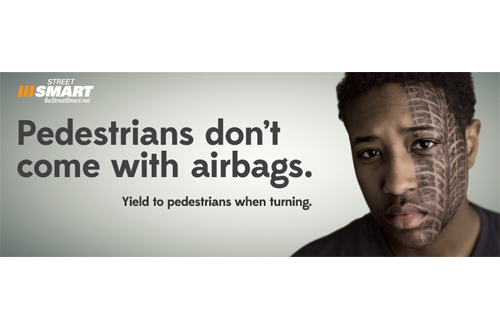
Street Smart Safety Tips


During the Street Smart campaign, which runs through May 13, law enforcement officers in Maryland, the District of Columbia and northern Virginia will be watching for motorists, pedestrians and bicyclists who violate traffic safety laws. Drivers and cyclists who fail to stop for pedestrians in crosswalks, as well as pedestrians who jaywalk, can face fines that range from $40 to $500. Drivers also are subject to getting points on their driver records.  Information on the new campaign and the Street Smart public education program may be found at www.bestreetsmart.net
Safety Tips:

If you’re driving…
• Slow down and obey the speed limit
• Look twice for people in crosswalks and yield to pedestrians and bicyclists
• Be careful when passing stopped vehicles
• Yield to pedestrians and cyclists at intersections when you're turning
• Allow three feet when passing bicyclists
• Look for cyclists and cars before you open your door
• Avoid using your cell phone and never text while driving

If you’re walking…
• Cross the street at the corner and use marked crosswalks when they’re available
• Wait for the “Walk” signal to cross the street
• Watch for turning vehicles. Before crossing look left, right, and left again
• Be seen! If you’re walking after dark or in bad weather, make it easier for drivers to see you by wearing light clothing or something reflective
• Don’t text while you’re crossing the street
• If you’re on an off-street trail, obey all posted signage and approach intersections with caution

If you’re biking…
• Obey all traffic signs and traffic signals
• Ride in the direction of traffic, at least a car door width away from parked cars
• Use hand signals so drivers, cyclists, and pedestrians know what you’re going to do
• Always wear a helmet
• Use lights if you’re riding at times of darkness
• If you’re on an off-street trail, obey all posted signage and approach intersections with caution
• Slow down and watch for pedestrians on sidewalks, trails and in crosswalks

Wednesday, May 16, 2012

10 Bike-Related Recalls to Check Out Before You Hit the Road

Bike to Work Day is this Friday.  In advance of that I would encourage all of you to take a peek at the chart below from our friends at the Consumer Product Safety Commission (CPSC) to check to see if your bikes,  components or accessories have been recalled before taking them out on the road this Friday (or any day).

As always when riding your bikes: Use Your Head and Wear a Helmet!

Happy biking this Friday!


Note: by clicking on any of the images below, you can view a larger version.
ProductRecall Press ReleaseHazardPhotos
Bridgeway Bicycles
(91,000 units)
11-331The bicycle chain can break, causing a rider to lose control and fall.Click For Larger Image
Trek 2012 FX and District bicycles
(27,000 units)
12-024The bolt that secures the seat saddle clamp to the seat post can break posing a fall hazard.Click For Larger Image
Fuji Saratoga Women's Bicycles
(10,500 units)
12-112The bicycle's frame can break in the center of the downtube during use, causing the rider to lose control and fall.Click For Larger Image
Public Bikes 2010 through 2012 Model Year Bicycles
(4,100 units)
12-145The pedals can crack and break, posing a fall hazard to the rider.Click For Larger Image
Specialized 2012 bicycles with Advanced Group carbon forks
(460 units)
12-096The brake component housed within the bicycle’s carbon fork can disengage from the fork and allow the brake assembly to contact the wheel spokes while rotating, posing a fall hazard.Click For Larger Image
Chariot bicycle trailers (44,000 units)
and bicycle trailer conversion kits (70,000 units)
12-085The bicycle trailer’s hitch mechanisms can crack and break, causing the trailer to detach from the bicycle. This poses an injury hazard to children in the bicycle trailer.Click For Larger Image
Topeak Babyseat® II Bicycle Carrier Seats
(40,000 units)
12-143A child can place his or her fingers in the opening at the grab bar’s hinge mechanism. When the consumer lifts the grab bar to remove the child from the seat, the child’s fingertips can be caught in the hinge mechanism, posing a laceration and fingertip amputation hazard to the child.Click For Larger Image
Little Tricky Bicycle Helmets
(30,400 units)
12-082Product testing demonstrated that these helmets do not comply with CPSC safety standards for impact resistance. Consumers could suffer impact head injuries in a fall.Click For Larger Image
GT, Giant and Trek Bicycles with SR Suntour Suspension Forks
(17,000 units)
12-149The suspension fork's internal support tubes can break and cause the rider to lose control, fall and crash.Click For Larger Image
Gore Bicycle Brake Cables for Road Bikes
(9,700 units)
12-125When the brake cables are installed on Campagnolo® style brake levers, they can detach, causing the brakes to fail and posing a fall hazard.Click For Larger Image
---

Monday, March 19, 2012

Riding a Bike During This Great Weather? Use Your Head and Wear a Helmet!


Kids and Bike Helmets: The Right Fit

Bike helmets are not optional equipment. A helmet is your last line of defense in an accident - never ride without one!
Kids should always wear helmets while biking
Helmets have been shown in studies to reduce the risk of head injury by 85 percent and the risk of brain injury by 90 percent. Nationally, only 15 percent of children bicyclists used bicycle helmets. Here are some points to consider when fitting a bike helmet on a child:
  • The helmet should sit on the child's head so that the front rim is just above the eyebrows. Use the two finger rule - leave about two fingers width between your eyebrows and the front of the helmet. If the helmet rests on the back of the head, the forehead, nose and chin will be exposed.
  • Before buckling the chin strap, have children shake their head from side to side. The helmet should generally stay put. If it moves excessively, it's too big and won't protect the head no matter how tight the chin strap is pulled. The straps should be joined just under each ear at the jawbone.
  • When the chin strap is buckled, children should be able to open their mouth and feel the helmet press firmly against the top of their head.
  • Buy a new helmet. Helmets that have suffered even a single fall or have been exposed to heat for a long time (i.e., kept in the trunk of a car) lose the cohesion that keeps the helmet intact during impact.
  • Don't forget to set an example by wearing a helmet yourself!

Bike Safety and Bike Helmets

Montgomery County requires anyone under age 18 to wear a bicycle helmet when riding or being carried on a bicycle, including a bicycle with training wheels, on a public street, right-of-way, sidewalk or bicycle path in the County. 1
Your child is 14 times more likely to survive a bike crash if he/she is wearing a helmet. Each year in the United States, approximately 250 children die in bicycle-related accidents, and about half a million are injured in bicycling accidents. Although it's estimated that 75% of the serious injuries could have been avoided if a helmet was worn, only about 20% of children in the United States wear a helmet.
How to properly wear a bike helmet

Get the Helmet to Fit Right

Step 1: Make sure the helmet fits firmly.
Helmets are sold with foam pads that differ in thickness to make the helmet fit firmly. Use the foam pads by attaching them to the inside of the helmet until the helmet fits firmly on your child's head. The helmet should not move around when shaken.
Step 2: Make sure the helmet sits level on the child's head.
This means the helmet should cover the top of the forehead, just above the eyebrows. Wearing the helmet too far back is a common mistake. You should be able to place just two fingers between the eyebrows and the front of the helmet. Take off anything that could change the way a helmet fits (baseball caps, big hair clips, headphones, etc.).
Step 3: Position the straps correctly.
All straps should be snug but still comfortable. Fix the side straps so that they fit around your child's ear in a V-shape. Adjust the buckles or slides on the side strap so that they are right under theear. Tighten the chin strap until you can fit just one finger between the strap and your child's chin.
Check the fit of the helmet every time. Use the 2-V-1 finger test. Teach your child to do this test each time he gets ready to ride:
  • Two fingers above the eyebrows
  • V-Shape under each ear
  • One finger under the chin strap
  • Make sure that the helmet has a label to say that it meets safety standards, such as CSA, CPSC, ASTM, or Snell.
After taking a serious hit, helmets lose their capacity to absorb shock. They're designed that way so that the inner foam structure is altered by a very hard blow. If your child ever has a significant fall or hits any surface hard with the helmet, immediately replace the helmet. Don't Negotiate. It is estimated that 75% of bicycle-related deaths among children could be prevented with a bicycle helmet. Wearing one should never be optional for your child.
1 Excerpted from the Montgomery County Code, Sec. 7-2 - Bicycle Helmets

Friday, May 20, 2011

Safety Tips for Bike To Work Day

Are you riding your bike to work today?  If so, make sure you do so safely!  Use your head and wear a helmet!

I found these Five Steps to Riding Better from the League of American Bicyclists that I thought some of you might find useful.

Be safe out there today and be seen!

-Bill

Five Steps to Riding Better
1. Follow the Rules of the Road
• Ride with traffic and obey the same laws as motorists.
• Use the rightmost lane that heads in the direction
that you are traveling.
• Obey all traffic control devices, such as stop signs,
lights, and lane markings.
• Always look back and use hand and arm signals
to indicate your intention to stop, merge or turn.
2. Be Visible
• Ride where drivers can see you.
• Wear brightly colored clothing at all times.
• At night, use a white front light and red rear light
or reflector. Wear reflective tape or clothing.
3. Be Predictable
• Ride in a straight line and don’t swerve between
parked cars.
• Make eye contact with motorists to let them
know you are there.
• Do not ride on the sidewalk.
4. Anticipate Conflicts
• Be aware of traffic around you and be prepared
to take evasive action.
• Learn braking and turning techniques to
avoid crashes.
• Be extra alert at intersections.
5. Wear a Helmet
• Make sure that the helmet fits on top of your
head, not tipped back or forward.
• After a crash or any impact that affects your
helmet, visible or not, replace it immediately.

Wednesday, July 22, 2009

Kids and Bike Helmets: The Right Fit

Bike helmets are not optional equipment. A helmet is your last line of defense in an accident - never ride without one!

Helmets have been shown in studies to reduce the risk of head injury by 85 percent and the risk of brain injury by 90 percent. Your child is 14 times more likely to survive a bike crash if he/she is wearing a helmet. Each year in the United States, approximately 250 children die in bicycle-related accidents, and about half a million are injured in bicycling accidents. Although it's estimated that 75% of the serious injuries could have been avoided if a helmet was worn, only about 20% of children in the United States wear a helmet.

Montgomery County requires anyone under age 18 to wear a bicycle helmet when riding or being carried on a bicycle, including a bicycle with training wheels, on a public street, right-of-way, sidewalk or bicycle path in the County.

For more information, go here: Bike Safety and Bike Helmets