Showing posts with label calling 911. Show all posts

Monday, April 4, 2016

Poll Result: Does Your Child Know Home Address And How To Call 911

Last Wednesday, we honored a wonderful seven year old girl who was able to call 911 to help her dad, who was experiencing a medical emergency, out. A great story you can learn more about here: Seven Year Old Everyday Hero Honored For Making The Right Call.

As a result we decided to take a poll, via our @MCFS Twitter page, and ask the below question re kids and calling 911. We are happy to see that 70% know their address and how to call 911.

Three percent indicate their child does not know either but will teach them right away. We will assume that the seven percent who know how to call 911 but do not know their address will be taught their address. Very nice to think that, as a result of the poll, some kids will be taught a valuable safety lesson that could save a life; much like seven year old Jenna did!

Of course, we here at MCFRS hope that no one ever has to call 911 as it means someone may be hurt and/or experiencing a fire.

Wednesday, March 30, 2016

Seven Year Old Everyday Hero Honored For Making The Right Call

Earlier today a seven-year-old Silver Spring girl, who recently called 911 to help her Dad, was honored as an “Everyday Hero” and met the MCFRS call taker/dispatcher, Amanda Poore, who took her 911 call. Jenna made the right call and got help to her home quickly.

Fire Chief Scott Goldstein praised Jenna for her quick thinking, calm demeanor and remembering her home address as she made her 911 call on Sunday, February 28. Chief Goldstein then presented Jenna with a medal and plaque in recognition of her outstanding effort and potentially lifesaving call.

Jenna was then treated to a tour of the MCFRS dispatch and communication area by Amanda.

MCFRS utilized Periscope to live stream the even and you can view the replay below along with other videos of the event.

Also below is an audio of Jenna’s 911 call.

MCFRS wants to know that, if needed, can you make the right call? When calling 911, know what to expect. Learn more here: What to Expect When You Call 911

As well, make sure your child knows their home address – or two if mom and dad live in different homes. Here is an activity for your child that we hope helps:  "Learn Your Address!" Activity for Kids


Tuesday, March 29, 2016

Seven Year Old Makes The Right Call

A seven-year-old Silver Spring girl who recently called 911 will meet the MCFRS call taker/dispatcher who assisted with the call. The young girl made the right call and got help to her home quickly.

She and her family will hear the 911 audio tape for the first time and have an opportunity to meet the call taker/dispatcher as well as tour the MCFRS dispatch and communication area.

The youngster and her family will meet MCFRS dispatchers at the Montgomery County Public Safety Communications Center, located at 1300 Quince Orchard Boulevard in Gaithersburg at 9:30 a.m. on Wednesday, March 30.

If needed, can you make the right call? When calling 911, know what to expect. Learn more here: What to Expect When You Call 911
     
Below is an excerpt from the 911 call.

Friday, March 13, 2015

Master Firefighter Branzell Signs Off

Master Firefighter John Branzell is retiring after 27 years with MCFRS. His current and last assignment was with the Emergency Communications Center (ECC) on B Shift. 

ECC is the primary link between a resident, who reports an emergency via 9-1-1, and the fire and rescue personnel and equipment, who respond to an incident scene. The ECC's mission is to obtain the necessary information to dispatch the proper response quickly, provide appropriate pre-arrival instructions, ensure fire and rescue response personnel have adequate situational awareness of the dispatched event, and to manage all response communications and technologies. Master Firefighter Branzell was considered one of the best in this business.


Master Firefighter Branzell, known to all as JB, provided one last transmission to all MCFRS personnel just prior to leaving (below).


JB will be missed and everyone in MCFRS wishes him a happy and healthy retirement.

Master Firefighter Branzell Signs Off
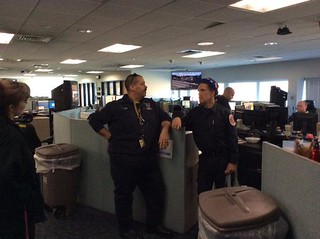
JB (r) talking with co-workers at ECC 3/12/15

Tuesday, April 9, 2013

Make The Right Call - April is National 9-1-1 Education Month.

For those of you not aware, April is National 9-1-1 Education month.  Please take a moment to review the below information as it relates to calling 9-1-1 or an alternate, non-emergency, number that may be more appropriate.

Stay Safe - Bill


The information in this brochure will help Montgomery County residents Make the Right Call by using 9-1-1 only for emergencies, 301-279-8000 only to report non-emergencies, and 3-1-1 for general Montgomery County government information. Having a better understanding of when to call each of these three important phone numbers will help ensure that your specific need is most effectively met.

This is a general information brochure. The examples included are guidelines. It does not list every incident for which you might need to contact 9-1-1, 301-279-8000, and 3-1-1.

When to call 9-1-1:

ONLY TO REPORT EMERGENCIES to Police, Fire/ Rescue, and to request an ambulance -- Available 24/7
  • Any life-threatening situation - fights, weapons, personal-injury vehicle collisions
  • A sexual assault that is in progress or has just occurred
  • An immediate fear for your personal safety or the safety of others
  • A serious crime in progress - robbery, burglary, assault
  • Any type of fire
  • Any serious medical problem that requires an ambulance or other immediate medical response

What should you (the caller) do when you call 9-1-1:

  • Remain calm and speak clearly
  • Be prepared to answer where, what, when, who, and how
  • Let the call taker ask the questions
  • Stay on the phone if it is safe to do so, or until the call taker advises you to hang up
  • If the call requires transfer to another agency, stay on the line. You may hear a series of clicks as the transfer occurs.
  • Understand that if the 9-1-1 center is extremely busy and your call is not answered within approximately 15 seconds, you will hear a recording indicating that operators are busy. The tones that follow the recording support devices for the hearing impaired. Stay on the line, do not hang up and call back.

What you’ll be asked when you call 9-1-1:

  • The location of the emergency – the exact address, intersection, place name (for example shopping center, school, hotel, etc.)
  • The nature of the emergency (what is going on right now, description of people and/or vehicles involved, any weapons involved, how long ago did the incident occur)
  • If it is a medical emergency you will be asked questions about the patient’s physical condition
  • Your (the caller’s) name and telephone number – a request to remain anonymous will be honored
  • Whether you want an officer to respond to see you
  • To be prepared to follow any instructions the call taker gives you. Call takers can provide step-bystep information about what to do until help arrives.

If you inadvertently dial 9-1-1 – DO NOT HANG UP:

  • Stay on the phone and advise the call taker that you mistakenly dialed 9-1-1 and that you do not have an emergency.
  • If a 9-1-1 call is abrupty disconnected, the call taker will attempt to call the number back.
  • If a caller does not confirm whether or not there is an emergency, police may be dispatched to the location from which the call was made.
  • To prevent inadvertent calls to 9-1-1, keep phones out of reach of toddlers and small children.
  • Use your phone wisely. Responding to unnecessary calls needlessly burdens the emergency call taker and the system, leaving the call taker unavailable for true emergencies.

When to call the Police Non-Emergency Number 301-279-8000:

TO REPORT LESS SERIOUS CRIMES, not to ask informational questions -- Available 24/7
  • A noise complaint
  • A parking violation
  • A property damage traffic collision where there is no personal injury
  • Loose or barking dogs
  • To report that you were a victim of a crime that is not in progress
  • To report a suspicious person, vehicle, or situation

When to call 3-1-1:

TO RECEIVE NON-EMERGENCY INFORMATION ABOUT MONTGOMERY COUNTY GOVERNMENT PROGRAMS AND SERVICES --M-F 7 a.m. - 7 p.m., closed weekends and holidays – A website, www.MC311.com is available 24/7.
The County will announce when the MC311 Center has been activated outside of regular hours to take informational questions during emergencies such as hurricanes, winter snow storms, etc.
  • For Ride On bus information
  • To discuss your Montgomery County property tax bill
  • For recycling and trash pick up information
  • For road and pothole repairs
  • For building, construction, and zoning information
  • To schedule construction permitting inspections
  • For Health and Human Services Information
  • To reach the MC311 Center from outside the County call 240-777-0311.

Special Caller situations: Deaf/hearing/speech-impaired callers

  • 9-1-1 and 301-279-8000 are equipped with the TTY/TDD interface
  • For TTY at the MC311 Center, call 301-251-4850
  • MD Relay service is available by dialing 7-1-1
  • For more information on MD Relay, go to www.mdrelay.org

English as a second Language:

  • Montgomery County subscribes to a Language Interpretation Service that is available for 9-1-1, 301-279-8000, and 3-1-1.
  • When language interpretation is needed, callers will be connected to the language interpretation service. When conferencing the interpreter in to the call, the caller may hear a series of beeps and tones. Do not hang up. Stay on the line until all three parties are on the phone together.
  • The Interpreter will ask the caller questions, then translate to the call taker. The call taker will then ask the interpreter questions to ask the caller.
IMPORTANT: Currently, 9-1-1, 301-279-8000, 3-1-1, and 240-777-0311 are not equipped to accept text messages.

Download Brochures ( English | Spanish ) in pdf format.
Montgomery County residents Make the Right Call by using
  • 9-1-1 only for emergencies,
  • 301-279-8000 only to report non-emergencies, and
  • 3-1-1 for general Montgomery County government information.
Having a better understanding of when to call each of these three important phone numbers will help ensure that your specific need is most effectively met.

From Montgomerycountymd.gov web site

Wednesday, September 26, 2012

Learn Your Address - An Activity for Kids!

Houses have numbers instead of names. Firefighters and police use those numbers to find houses in an emergency so they can help you. The number you see on the front of your house is your home's first name. The street name or number is your home's last name. The home's first name and last name together make up your address. This house's first name is: 5677 (first) Piringer Street SW (last).

Instructions

Adobe PDF Download (PDF, 160 Kb) and print this page and have a grown up write your house's name (address) on the lines below. Read it out loud.
House with the number 5677 located on Piringer Street Southwest
First Name (House number) -


Last Name (Street) -


Now copy your address. Color the house above the same colors as your home.


Help us help you - please make sure your house numbers are visible from the street and help your child learn his/her address and phone number. Hang this sheet up near your phone while your child is learning.

Wednesday, April 18, 2012

Can we find you in an EMERGENCY?


In an emergency, police, fire and rescue workers depend on house numbers to find YOU as quickly as possible. Finding your home - especially at night - can be challenging if address numbers are unreadable, hidden, unlighted or have missing numbers and may delay emergency responders from getting to you as quickly as possible.
Are your house numbers visible?Are your house numbers visible from the street? Are they set on a background of contrasting color? If your house is hidden from the street, are your numbers attached to a visible fence, mailbox or gate? Is your mobile home identified with your house number? If you live on a corner, does your house number face the street named in your address?
If you've answered "no" to any of these questions, please follow the guidelines below to make sure your house number is easy to read:
  1. Numbers must be visible from the street. Existing residential home numbering can be 3 1/2 inches high, however new residential homes must be at least 5 inches high and if you replace existing numbers they must be at least 5 inches high.
  2. Numbers should be placed on a contrasting background, with a reflective coating on the numbers for easy visibility at night.
  3. Repair or replace aging address number placards, especially on mailboxes that are a distance from the front of the residence.
  4. Prune any bushes, tree limbs or other growth that has covered your house numbers.
  5. Numbers should be placed on or beside the front door. If your door is not easily seen from the street, put the numbers on a post, fence or tree at the driveway entrance so they can be clearly seen from the street. In addition to numbers on the front door of your house, if you have a rural-style mailbox, reflective and contrasting numbers should be placed on both sides of the box so they can be seen by an emergency vehicle approaching from either direction.

Montgomery County Code on Addresses

  1. The owner of any structure presently existing or constructed in the future must display Arabic numbers designating the address assigned to the structure by the Maryland-National Capital Park and Planning Commission, or by the municipality in which the structure is located. Numbers must be at least five (5) inches high for single-family detached and attached residences and at least six (6) inches high for commercial, industrial or multifamily structures. However, if the numbers designating the address of a single-family residence on April 5, 1988, were at least three (3) inches high, those numbers comply with the size requirement of this section as long as they remain in place. Address displays must be posted on a contrasting background displayed in a conspicuous place that is unobstructed and clearly readable from the street named in the official address of the structure. Where a structure has more than one (1) address or where more than one (1) structure shares a common entry or driveway, numbers must designate the addresses in sequence.
  2. An agency of the county must not require a permit for a sign containing only the address of a residence if the sign is smaller than a maximum size set by the county executive by regulation.

Monday, January 23, 2012

Are You Looking for an Exciting Career? MCFRS is Accepting Applications for Public Safety 911 Call Taker


      Closing Date: January 25, 2012

      Rockville - - - The Montgomery County Fire and Rescue Service (MCFRS) is recruiting for the position of Public Safety 911 Call Taker for the Emergency Communications Center (ECC) located in Gaithersburg, Maryland. This recruitment will establish an eligible list to fill current and future vacancies. Selected candidates may be assigned to the Fire/Rescue Service.

The Public Safety 911 Call-Taker is responsible for quality emergency communication services to the citizens of Montgomery County as well as providing accurate and timely data/support to uniformed fire/rescue radio dispatchers. The Public Safety 911 Call-Taker has a unique responsibility in a fast-paced environment that requires careful attention to detail, multi-tasking and good communication skills.

      Duties will include: answering 911 emergency calls related to fire/rescue and emergency medical services; utilizing specific protocols to screen and prepare calls for dispatch, interacting with uniformed fire/rescue radio dispatchers via a Computer-Aided Dispatch (CAD) system; and providing Dispatch Life Support (pre-arrival) instructions to 911 callers as mandated by the State of Maryland.

Employment Information:
Applicants must have the ability to:

-         perform work assignments at different work locations when required;
-         work holidays, weekends and shifts during days, evenings or midnights;
-         accept last minute changes to their schedule and work mandatory overtime;
-         work under close supervision and daily evaluation of performance, especially during training;
-         demonstrate good customer service skills including dealing calmly and respectfully with irate and angry customers over the phone while handling complex situations; and
-         work under constant electronic surveillance as all telephone conversations and radio messages will be recorded.
 
      Successful candidates will be required to obtain a State of Maryland Emergency Medical Dispatcher licensure/certification within six (6) months of employment and maintain licensure/certification after the probationary period.

      Salary Range: $35,923 - $58,693

Minimum Qualifications:
Experience: One (1) year of responsible work experience involving public contact.
Education: Completion of high school or High School Certificate of completion recognized in the State of Maryland.
Equivalency: None.

Preferred Criteria:
Resume must include information specific to the preferred criteria listed below. Make sure that your resume references your knowledge, skills, and abilities as they relate to the preferred criteria. Ideally, the preferred criteria should be addressed in a separate section in your resume.  The system only allows for one document to be submitted so your preferred criteria must be part of the resume.

There are no preferred criteria for this requisition.  Applicants that meet the minimum qualifications will be required to take qualifying assessments.

If selected for consideration for this position, you may be required to provide evidence that you possess the knowledge, skills, and abilities indicated on your resume.

Additional Employment Information:
Montgomery County Government is an equal opportunity employer, committed to workforce diversity. Accordingly, as it relates to employment opportunities, the County will provide reasonable accommodations to applicants with disabilities, in accordance with the law. Applicants requiring a reasonable accommodation for any part of the application and hiring process should contact the Office of Human Resources via email to special.accommodations@montgomerycountymd.gov. Individual determinations on requests for reasonable accommodation will be made in accordance with all applicable laws.

Montgomery County Government also provides hiring preference to certain categories of veterans and veterans/persons with a disability. For more information and to claim employment preference, please refer to the Careers webpage on Hiring Preference.
    
For important information regarding the recruitment process, critical dates and information, applicants should access the job posting at:  www.montgomerycountymd.gov and click on careers. 

Friday, December 23, 2011

Can we find you in an EMERGENCY?


Are your house numbers visible?
In an emergency, police, fire and rescue workers depend on house numbers to find YOU as quickly as possible. Finding your home - especially at night - can be challenging if address numbers are unreadable, hidden, unlighted or have missing numbers and may delay emergency responders from getting to you as quickly as possible.
Are your house numbers visible from the street? Are they set on a background of contrasting color? If your house is hidden from the street, are your numbers attached to a visible fence, mailbox or gate? Is your mobile home identified with your house number? If you live on a corner, does your house number face the street named in your address?
If you've answered "no" to any of these questions, please follow the guidelines below to make sure your house number is easy to read:
  1. Numbers must be visible from the street. Existing residential home numbering can be 3 1/2 inches high, however new residential homes must be at least 5 inches high and if you replace existing numbers they must be at least 5 inches high.
  2. Numbers should be placed on a contrasting background, with a reflective coating on the numbers for easy visibility at night.
  3. Repair or replace aging address number placards, especially on mailboxes that are a distance from the front of the residence.
  4. Prune any bushes, tree limbs or other growth that has covered your house numbers.
  5. Numbers should be placed on or beside the front door. If your door is not easily seen from the street, put the numbers on a post, fence or tree at the driveway entrance so they can be clearly seen from the street. In addition to numbers on the front door of your house, if you have a rural-style mailbox, reflective and contrasting numbers should be placed on both sides of the box so they can be seen by an emergency vehicle approaching from either direction.

Montgomery County Code on Addresses

  1. The owner of any structure presently existing or constructed in the future must display Arabic numbers designating the address assigned to the structure by the Maryland-National Capital Park and Planning Commission, or by the municipality in which the structure is located. Numbers must be at least five (5) inches high for single-family detached and attached residences and at least six (6) inches high for commercial, industrial or multifamily structures. However, if the numbers designating the address of a single-family residence on April 5, 1988, were at least three (3) inches high, those numbers comply with the size requirement of this section as long as they remain in place. Address displays must be posted on a contrasting background displayed in a conspicuous place that is unobstructed and clearly readable from the street named in the official address of the structure. Where a structure has more than one (1) address or where more than one (1) structure shares a common entry or driveway, numbers must designate the addresses in sequence.
  2. An agency of the county must not require a permit for a sign containing only the address of a residence if the sign is smaller than a maximum size set by the county executive by regulation.

Thursday, July 14, 2011

Can we find you in an EMERGENCY?

In an emergency, police, fire and rescue workers depend on house numbers to find YOU as quickly as possible. Finding your home - especially at night - can be challenging if address numbers are unreadable, hidden, unlighted or have missing numbers and may delay emergency responders from getting to you as quickly as possible.

Are your house numbers visible from the street? Are they set on a background of contrasting color? If your house is hidden from the street, are your numbers attached to a visible fence, mailbox or gate? Is your mobile home identified with your house number? If you live on a corner, does your house number face the street named in your address?

If you've answered "no" to any of these questions, please follow the guidelines below to make sure your house number is easy to read:
  1. Numbers must be visible from the street. Existing residential home numbering can be 3 1/2 inches high, however new residential homes must be at least 5 inches high and if you replace existing numbers they must be at least 5 inches high.
  2. Numbers should be placed on a contrasting background, with a reflective coating on the numbers for easy visibility at night.
  3. Repair or replace aging address number placards, especially on mailboxes that are a distance from the front of the residence.
  4. Prune any bushes, tree limbs or other growth that has covered your house numbers.
  5. Numbers should be placed on or beside the front door. If your door is not easily seen from the street, put the numbers on a post, fence or tree at the driveway entrance so they can be clearly seen from the street. In addition to numbers on the front door of your house, if you have a rural-style mailbox, reflective and contrasting numbers should be placed on both sides of the box so they can be seen by an emergency vehicle approaching from either direction.

Montgomery County Code on Addresses

  1. The owner of any structure presently existing or constructed in the future must display Arabic numbers designating the address assigned to the structure by the Maryland-National Capital Park and Planning Commission, or by the municipality in which the structure is located. Numbers must be at least five (5) inches high for single-family detached and attached residences and at least six (6) inches high for commercial, industrial or multifamily structures. However, if the numbers designating the address of a single-family residence on April 5, 1988, were at least three (3) inches high, those numbers comply with the size requirement of this section as long as they remain in place. Address displays must be posted on a contrasting background displayed in a conspicuous place that is unobstructed and clearly readable from the street named in the official address of the structure. Where a structure has more than one (1) address or where more than one (1) structure shares a common entry or driveway, numbers must designate the addresses in sequence.
  2. An agency of the county must not require a permit for a sign containing only the address of a residence if the sign is smaller than a maximum size set by the county executive by regulation.